By Margaret Hale
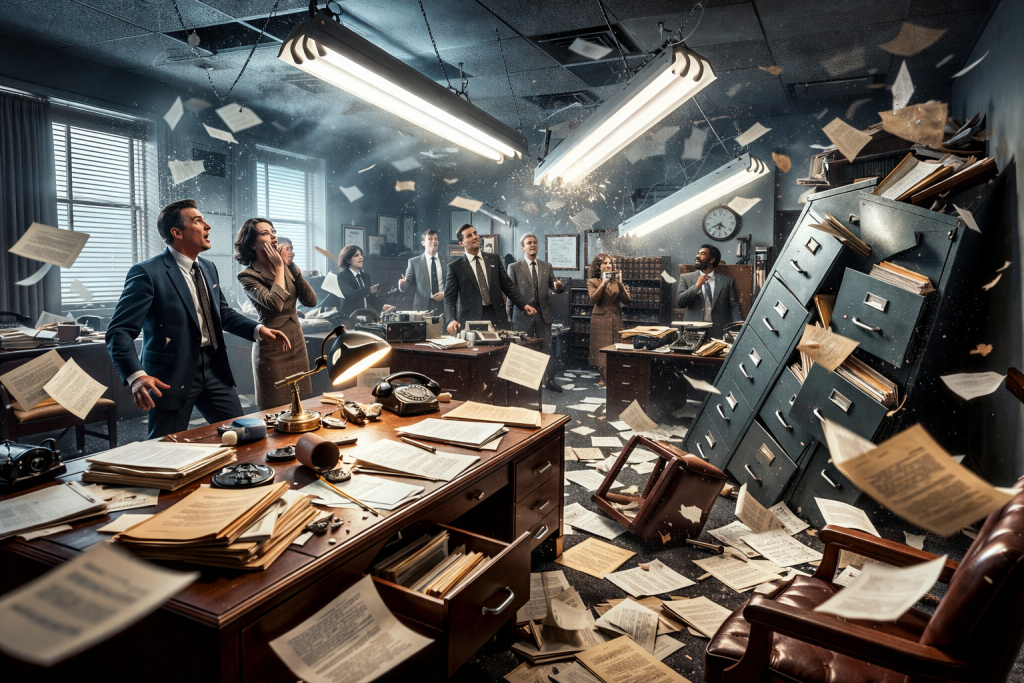
The town of Rosenheim in Bavaria is a picture of order. With its baroque architecture and quiet streets, it feels anchored in history and tradition. However, in the winter of 1967, a small law office located at Kapuzinerstrasse 7 became the epicenter of a disturbance that challenged the rationality of everyone who entered. It began subtly. It was the kind of beginning that is often dismissed as a trick of the mind or a simple malfunction of the modern world.
Sigmund Adam, the lawyer who owned the practice, first noticed the anomaly in early December. The telephones began to act strangely. They would ring, but when answered, there was no one on the line. The dial tones would disappear, replaced by silence or strange clicking sounds. Technicians from the German Federal Post Office were called to investigate. They checked the lines, the switchboard, and the connections. They found no faults. Yet the disturbances continued. Calls were being made to the speaking clock without any human interaction. The bills mounted, and the frustration grew.
Soon, the phenomena expanded beyond the communication system. The atmosphere in the office shifted. It became heavy, oppressive. Staff members reported feeling a distinct drop in temperature in certain rooms. Then came the physical manifestations. File drawers, heavy and filled with legal papers, slid open on their own. Bookshelves were found in disarray, volumes pulled from their places and stacked on the floor. But it was the lighting that truly shattered the nerves of the employees.
Fluorescent tubes on the ceiling began to swing back and forth. This was not a gentle motion caused by a draft. They twisted violently, sometimes popping out of their fixtures and falling to the floor, shattering into shards of glass. On one occasion, a heavy filing cabinet, bolted to the wall, was torn from its moorings. The noise was loud, a sudden crash that sent the secretaries running from the room in panic.
The focus of the activity seemed to center around a young secretary named Annemarie Schneider. When she was present, the events were frequent and intense. Lights swung, lamps spun in circles on the desks, and pictures jumped from the walls. When she left the office, the disturbances ceased. This correlation was noted by the witnesses but not spoken of with judgment. The girl herself seemed exhausted, frightened by her own proximity to the chaos.
The situation escalated to the point where the police had to be involved. Officers arrived, expecting to find a prank or a structural fault. Instead, they witnessed the unexplainable. They stood in the office and watched as a light bulb unscrewed itself from its socket and fell. They saw drawers open. The officers signed witness reports, documenting what they saw with professional detachment. They could not explain it, but they could not deny it.
Physicists and parapsychologists were eventually brought in. They installed measuring devices. They recorded sudden spikes in electromagnetic energy that coincided with the physical movements. They photographed the chaos. The case became a study in how physical space reacts to unseen forces. The energy in the room was described as palpable, a sense of pressure that built up and released in kinetic bursts.
For Sigmund Adam and his staff, the law office was no longer a place of work. It was a place of fear. The familiar sounds of typing and shuffling papers were replaced by the sound of breaking glass and groaning furniture. The incident eventually faded over time, moving with Annemarie when she left her position. The office returned to normal, leaving behind a file of police reports and witness testimonies that document a period where the walls themselves seemed to rebel.
Leave a Reply