By Jonah Reed
The Pacific Ocean holds a depth of silence that few on land ever truly comprehend. It is a silence punctuated by the rhythmic hum of engines and the endless rolling of waves. For the crew of the USS Stein, a Knox-class destroyer escort, this rhythm was broken in 1978 during a routine patrol. The ship, designed for anti-submarine warfare, carried the most sensitive listening equipment the United States Navy possessed. But nothing in the technical manuals could prepare the sonar operators for what their screens would register, or fail to register, in those dark waters.
The incident began with a sudden, jarring vibration that shuddered through the hull. It was not the familiar thud of a depth charge or the distant rumble of a storm. It felt organic, heavy, and immensely powerful. On the bridge, the officers noted a momentary drag in the ship’s forward momentum. Below deck, in the dimly lit sonar room, the operators watched their displays in confusion. The AN/SQS-26 sonar, capable of tracking submarines miles away, was suddenly deafened by a barrage of high-frequency noise that overloaded the sensors.
The crew immediately assumed a collision with a submerged object, perhaps a shipping container or a whale. The captain ordered the ship to reduce speed and launched a damage control assessment. Divers were prepared, but the initial exterior check from the deck revealed nothing in the churning wake. The sea remained an opaque grey, offering no answers. The ship limped back toward its home port in San Diego, the hull vibrating with an unfamiliar resonance that set the crew on edge.
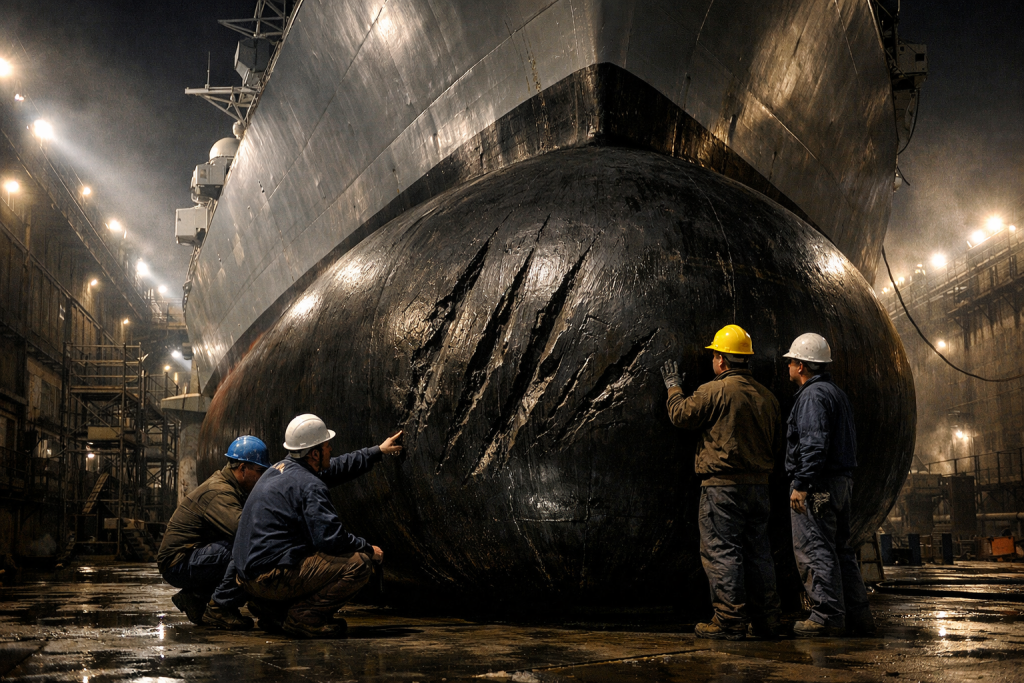
When the USS Stein was finally dry-docked at the Long Beach Naval Shipyard, the true extent of the encounter became visible. Technicians gathered around the bow, their faces illuminated by the harsh work lights. The massive sonar dome, a rubberized protective cover located beneath the waterline, had been severely compromised. It was not simply dented or scratched. The thick, reinforced rubber appeared to have been gouged and torn by something with immense strength.
Upon closer inspection, the damage revealed a terrifying pattern. Embedded in the rubber coating were long, deep cuts that resembled the rake marks of a giant claw. The wounds ran in parallel lines, suggesting a creature of colossal proportions. The technicians estimated that whatever had struck the dome possessed claws or tentacles tipped with hard, sharp material, capable of tearing through layers designed to withstand the crushing pressure of the deep ocean.
Biologists were called in to examine the gashes. They found biological material, traces of tissue that did not immediately match known whale species or sharks. The pattern of the cuts suggested a struggle, as if something had latched onto the ship and held on before being torn away by the vessel’s speed. Analysis pointed to the possibility of a colossal squid, or an unknown species of colossal marine predator. However, the size of the creature required to inflict such damage on a moving destroyer defied the known limits of existing marine biology.
The official reports logged the incident as a collision with an “unknown biological entity.” For the crew, the incident remained a visceral memory. It was the moment the ocean reminded them of its vast, unexplored territories. They had touched the bottom of the world, or rather, something from the bottom had touched them. The ship was repaired, the rubber dome replaced, but the logs of the USS Stein carry a permanent footnote about that silent strike in the Pacific, a testament to the unseen giants that roam the deep.
Leave a Reply