By Daniel Frost
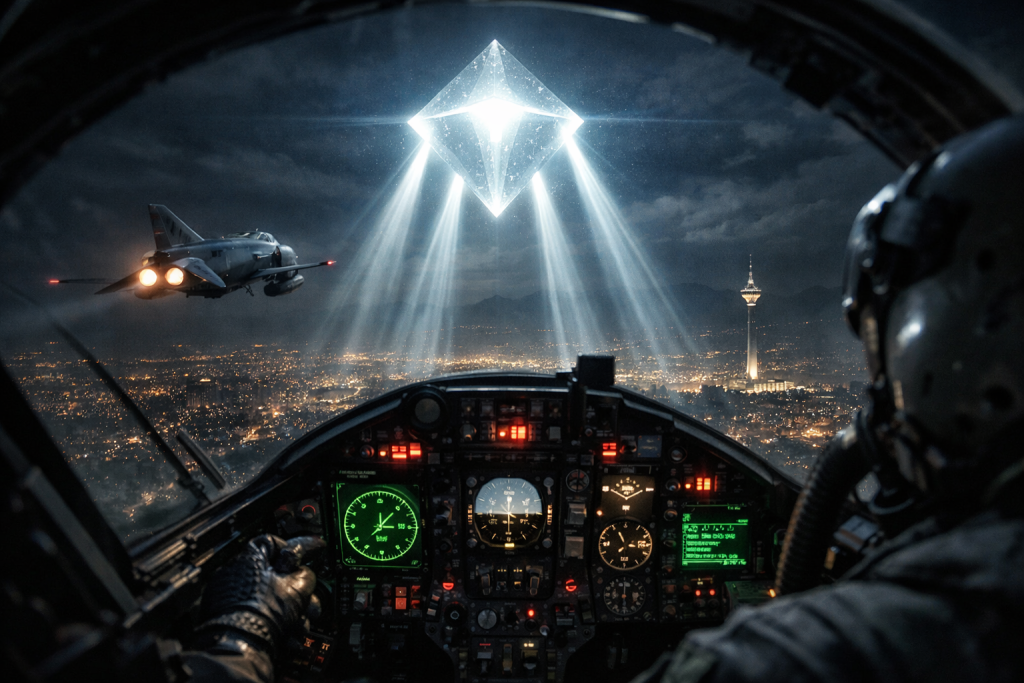
In the early hours of September 19, 1976, the skies over Tehran, Iran, became the stage for a military engagement that defied the technical capabilities of the era. The incident began with a series of telephone calls to the control tower at Mehrabad Airport. Citizens reported a bright object hovering in the sky. The object was described as luminous, comparable in size to a commercial airliner, and emitting intense beams of light. The reports were consistent and numerous enough to warrant official attention.
General Yousefi, the deputy commander of operations for the Iranian Air Force, was on duty that night. After verifying the visual reports from his own officers on the ground, he made the decision to scramble an F-4 Phantom II jet from Shahrokhi Air Force Base. The pilot, assigned the call sign “Jafari,” was tasked with intercepting and identifying the unknown aerial object. The mission was standard procedure for a perceived airspace violation.
At approximately 1:30 AM, the F-4 Phantom launched. As the jet climbed to an altitude of 1,000 feet, the pilot established visual contact with the object. He described it as a brilliant light source, far exceeding the luminosity of a standard aircraft. The object was located near the oil refinery of Rey, south of Tehran. Jafari attempted to close the distance to achieve a radar lock. As the F-4 accelerated toward the target, the object reacted. It accelerated away from the jet, maintaining a precise separation distance. Jafari noted that the object seemed to anticipate his maneuvers.
At a range of 25 nautical miles, the pilot activated his weapon control system. The radar locked onto the target for a brief moment. Then, a technical failure occurred. The pilot reported that his control panel went dark. He lost all instrumentation and communications. The F-4 was effectively disabled in mid-flight. Jafari broke off the pursuit, turning his aircraft back toward base. As he retreated, the systems on the F-4 spontaneously restored themselves.
A second F-4 was scrambled to replace the first. This pilot observed the object more closely. He reported that the primary object was diamond-shaped, with a central pulsing light. As he approached, the object released a smaller, luminous sphere. The smaller object moved at high speed toward the F-4. Fearing a collision or an attack, the pilot considered ejecting. However, the smaller object passed close by the jet and then circled around it. The pilot attempted to lock his radar onto the smaller object, but again, the weapons system failed to function. The smaller object eventually returned to the primary object and merged with it.
The incident concluded with the primary object descending rapidly. It landed on the ground near an oil refinery. The pilot and the control tower observed the stationary glow from the ground. A helicopter dispatched the following morning found no physical trace at the coordinates.
The documentation of this event is extensive. It includes the pilot’s flight logs, the tower’s communication records, and a secret report eventually declassified by the US Defense Intelligence Agency (DIA). The report highlights the failure of the F-4’s sophisticated electronic warfare systems in the presence of the object. The archive documents this event as a confirmed military observation where technology failed in the face of an unidentified phenomenon.
Leave a Reply