By Victor Lane
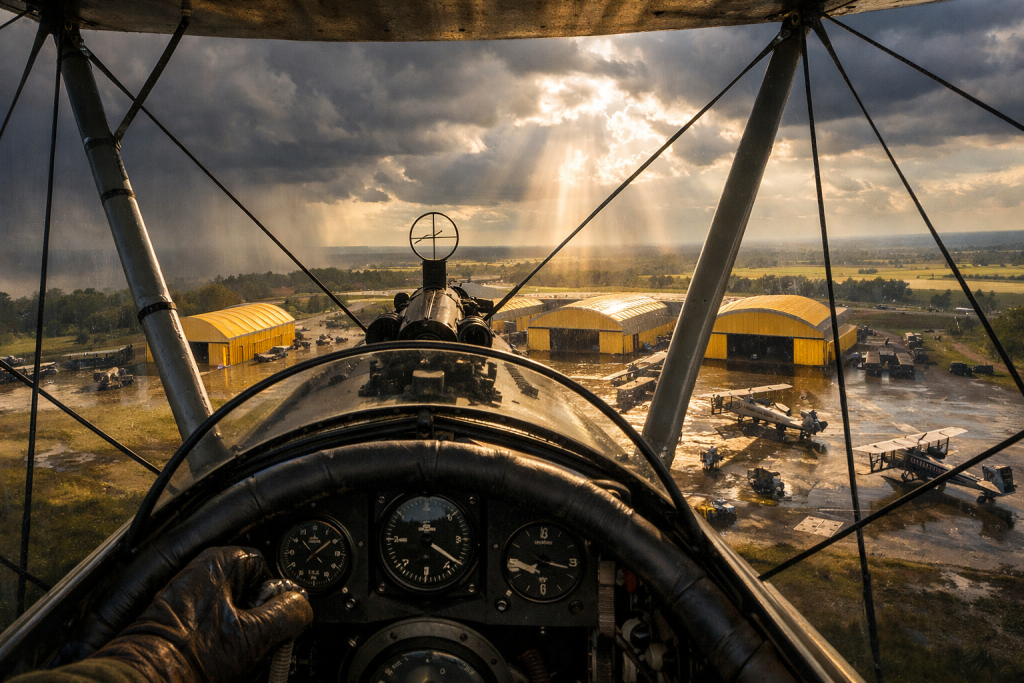
On January 17, 1935, Squadron Leader Victor Goddard of the Royal Air Force conducted a routine inspection flight over Scotland. The mission was to assess the condition of several abandoned airfields from the First World War. The specific target of this observation was the Drem Airfield, located near Edinburgh. The event is documented through official flight logs and subsequent verification of the site’s physical state.
Goddard departed from Donibristle in a Hawker Hart biplane. The weather conditions were reported as poor, with low cloud cover and heavy rain showers. Upon approaching the coordinates of Drem Airfield, the pilot noted a sudden change in atmospheric conditions. The rain ceased abruptly. The clouds lifted to reveal clear sunlight over the airfield below. This meteorological shift was localized to the immediate vicinity of the target location.
From an altitude of approximately 500 feet, Goddard observed the airfield. According to his prior knowledge and official records, the site was derelict. The hangars were expected to be roofless and the grass overgrown. However, the visual data contradicted these records. The hangars appeared repaired with new yellow roofs. The grass was neatly mowed. Several aircraft were positioned on the ground. Goddard identified them as Hawker Fury fighters, painted in yellow training livery. This configuration did not exist in 1935. The Royal Air Force did not adopt yellow training paint schemes until 1938.
The pilot descended to a lower altitude for confirmation. He observed ground crew personnel working around the aircraft. They wore coveralls of a specific blue shade that was not standard issue at the time. One mechanic looked up and waved at the aircraft. Goddard noted the man’s face clearly. He later identified the individual as a mechanic named Sammy, who had died in a crash two years prior to this flight.
The engine of the Hawker Hart began to fail during the observation. Goddard decided to abort the landing and return to base. As he increased throttle and turned away from the airfield, the weather conditions reverted instantly. The clear sunlight was replaced by the original heavy rain and low clouds. The visibility dropped to near zero within seconds.
Upon landing at Donibristle, Goddard filed a report detailing the discrepancy. He stated that the airfield appeared to be in a future state of repair. The claim was met with skepticism by command staff. The official records confirmed that Drem Airfield was indeed abandoned and dilapidated on January 17, 1935.
Three years later, in 1938, the Royal Air Force began refurbishing Drem Airfield. The work proceeded exactly as Goddard had described. The hangars were painted yellow. The grass was maintained. Hawker Fury aircraft were stationed there for training purposes. The ground crew uniforms matched the blue coveralls observed during the flight. The layout of the buildings and the position of the hangars corresponded to the visual data collected in 1935.
Goddard never claimed to understand the mechanism of the event. He maintained that he observed a physical location in a state that did not yet exist. The flight logs remain archived in the Royal Air Force records. The case is notable for the specific details regarding aircraft livery and infrastructure that were verified three years post-observation. There were no radio communications with the ground crew. There was no physical interaction with the objects observed.
The incident remains classified under anomalous temporal observation. No explanation was provided by intelligence agencies regarding the nature of the visualization. Goddard continued his service without further incidents of this nature. The Drem Airfield served as a training base throughout the Second World War. The correlation between the 1935 observation and the 1938 reality remains unexplained. The data suggests a breach in chronological consistency, documented by a trained observer with verified credentials.
Leave a Reply