By Victor Lane
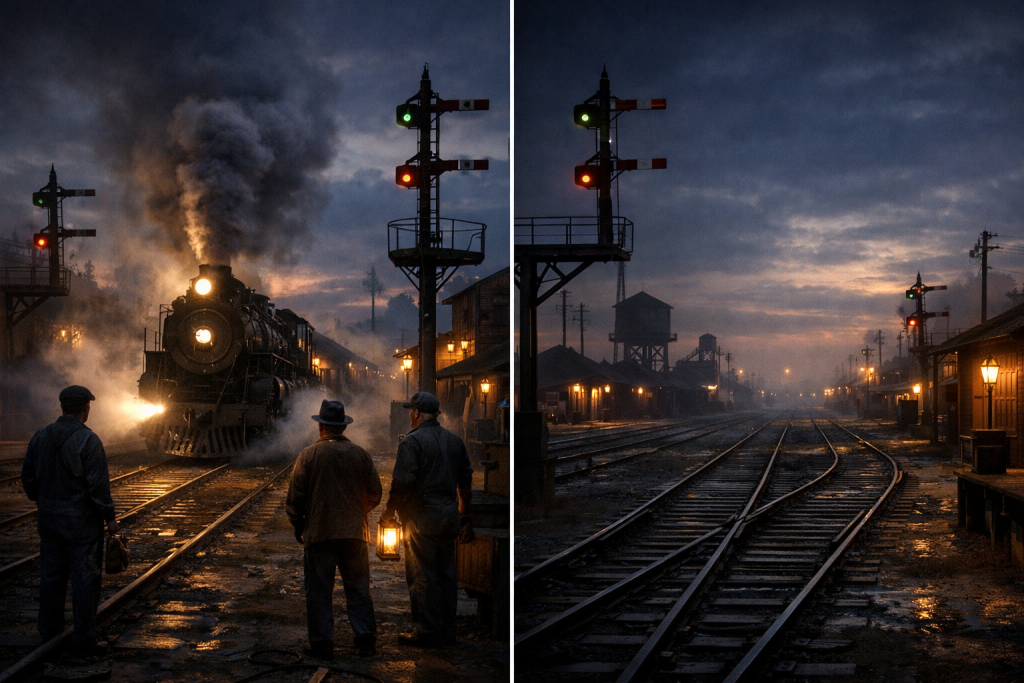
On March 14, 1911, employees of the Santa Fe rail yard in San Bernardino, California, documented an irregular report concerning a freight locomotive that failed to arrive on schedule. The publication date of this account follows more than a century later; the incident date remains March 14, 1911.
The locomotive, designated in yard logs as Engine No. 482, departed Barstow earlier that afternoon. Weather conditions were clear. Telegraph communication between stations confirmed departure time. Estimated arrival in San Bernardino was logged for 6:40 p.m.
At 6:55 p.m., the train had not arrived.
Telegraph operators along the route were contacted. Intermediate stations confirmed that the train had passed according to prior reports. No derailments were recorded. No obstructions were identified on the line.
At approximately 7:12 p.m., yard personnel reported hearing a whistle consistent with Engine No. 482 approaching from the east. Several workers later stated that they saw the headlamp of a locomotive emerging along the expected track corridor.
The light was described as visible for several seconds.
According to two switch operators, the locomotive entered the yard limits at reduced speed. They observed freight cars behind it. One worker reported noting the engine number plate as it passed beneath a signal lamp. The train continued forward into a section of track partially obscured by maintenance sheds.
Moments later, no locomotive was visible.
Workers moved toward the track section. The rails were clear. No freight cars were present. No smoke or steam remained in the air. The yard log for that hour contains a brief handwritten notation: “Engine 482 sighted, no arrival.”
Telegraph lines were rechecked. At 8:03 p.m., a message was received from Colton station indicating that Engine No. 482 had arrived there unexpectedly, having bypassed San Bernardino. The crew reported no irregularities. They stated that they had passed San Bernardino without stopping due to signal alignment.
Signal operators in San Bernardino reviewed their records. Signals were logged as set for arrival. No mechanical failure was documented.
The discrepancy between the reported visual observation in San Bernardino and the arrival confirmation in Colton remains in archived rail correspondence dated March 15, 1911. The rail company conducted an internal review. No formal explanation was recorded in surviving summaries.
Engine No. 482 continued service thereafter. No subsequent irregularities were attributed to it in available records.
The rail yard still operates in San Bernardino. Tracks converge as they did in 1911. On March 14 of that year, according to written logs and witness statements, a locomotive was both reported passing through the yard and officially recorded as never arriving.
The documentation remains.
Leave a Reply