By Jonah Reed
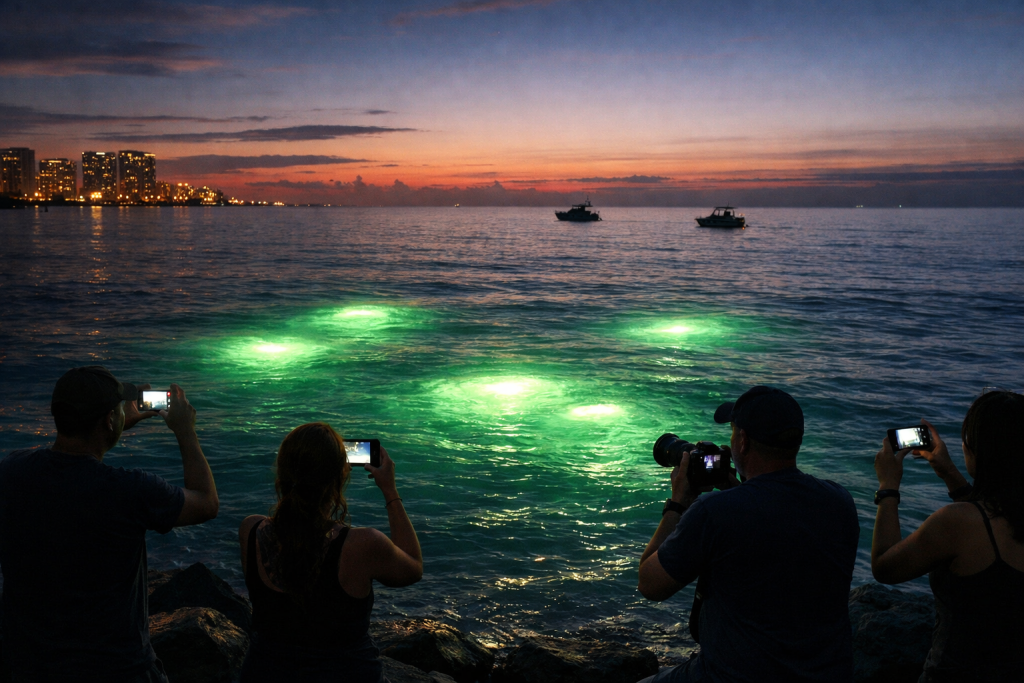
In 2025, an extraordinary pattern of maritime anomaly reports drew attention from civilian observers, technology analysts, and naval experts across the United States. Multiple eyewitness accounts, backed by thousands of entries in specialized tracking databases, described unusual objects either submerged beneath coastal waters or appearing to transition between air and sea — phenomena that did not fit conventional marine or aerial classifications. These reports were compiled through late summer and early autumn, particularly along the Atlantic and Pacific coastlines.
The unusual trend first gained public notice in mid‑2025 through data collected by Enigma, an online platform that aggregates sightings of unidentified aerial and maritime phenomena. According to the platform’s reports, over 9,000 incidents of unexplained submersible objects — often referred to as USOs (Unidentified Submersible Objects) — were recorded near U.S. territorial waters between early August and October of that year.
Eyewitness submissions came from a wide range of observers: commercial and recreational mariners, coastal residents, and users of marine tracking applications. Many reports described bright glowing entities beneath the ocean surface. One commonly shared description involved two green lights moving just below the water near Fort Lauderdale, Florida, captured in a brief video clip that circulated widely among online maritime communities.
In some cases, observers reported that these submersible objects did not behave like known marine vessels or creatures. According to compiling sources, objects appeared to:
- move at unusual speeds inconsistent with conventional underwater craft,
- display illumination patterns not attributable to standard navigation lights,
- transition from underwater movement to brief appearances at or above the surface without creating expected wakes.
These characteristics, in combination with the volume of reports, galvanized discussion among maritime technology analysts. Some experts noted that Enigma’s dataset included nearly 500 anomalies within five miles of shorelines, and more than 150 reports described objects “hovering” near or just below the water’s surface.
The regional distribution of sightings varied, with higher counts reported off the coasts of California and Florida. According to the aggregated data, California accounted for approximately 389 submersible object reports, while Florida had around 306 in the same period.
The unusual volume of reports prompted informal responses from some naval analysts and retired military personnel. Discussions in public forums and specialist blogs referenced historical precedent, such as the well‑documented 2019 encounter off San Diego involving the USS Omaha, where naval crews observed unidentified objects that interacted with surface and subsurface environments before disappearing without explanation. Those historical incidents have explored the possibility of trans‑medium craft — objects capable of operating both in water and air — though no official conclusion was ever reached.
Despite the scale and consistency of the dataset, U.S. naval authorities and government maritime agencies did not immediately release formal statements verifying the unusual reports. Representatives of coastal safety and oceanographic research institutions confirmed that no official attribution had been made to known marine technology tests, civilian vessels, or natural phenomena that could account for the sheer number and variety of submissions. Some maritime professionals expressed concern, suggesting that anomalous underwater activity near commercial shipping lanes and naval deployments could pose security or navigational risks if unidentified craft were genuinely present.
Skeptical voices proposed alternative explanations, ranging from errors in tracking software to misinterpretations of common maritime phenomena such as bioluminescent organisms, fishing lights, or optical effects caused by water surface reflections. Others pointed to the limitations of crowd‑sourced reporting, cautioning that data collected through public apps can mix credible sightings with misidentified or unrelated observations.
However, for many contributors to the Enigma database and for communities that follow unconventional marine reports, the sheer number of submersible object accounts remained striking. They pointed to the consistency of certain descriptions — the greenish glow, the motion beneath the surface, and the sudden appearances near shorelines — as elements that resisted easy classification.
In the months following the initial surge of reports, online maritime forums and anomaly tracking platforms continued to accumulate new submissions from coastal observers. Enthusiasts and analysts compared the volume of sightings to trends in other types of unidentified phenomena, noting that unusual reports at sea often pose unique challenges due to the vastness of the ocean and the relative scarcity of high‑fidelity observation technology compared to aerial or terrestrial environments.
The wave of reported submersible anomalies in 2025 represents one of the most extensive compilations of potential underwater unidentified phenomena in recent history. Whether driven by truly unexplained underwater objects or a complex interplay of observational artefacts and environmental effects, the dataset continues to attract interest from both specialist communities and casual observers alike.
For those who submitted accounts, and for many who reviewed the footage and logs, the ocean’s depths on those late summer nights appeared to hold more mysteries than official records could immediately explain.
Leave a Reply