Daniel Frost
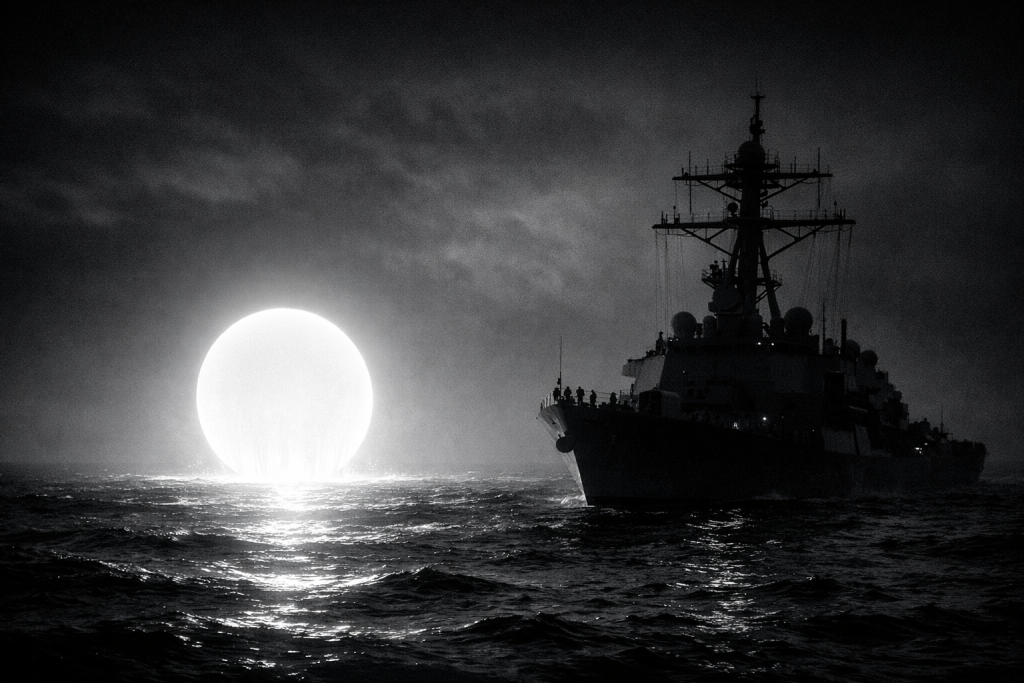
On July 15, 2019, the USS Omaha, a littoral combat ship operating off the coast of San Diego, was conducting routine operations in controlled waters. The night was clear. The sea was calm enough for standard surveillance conditions. Nothing in the initial reports suggested anything unusual.
Then the radar picked up multiple contacts.
Operators observed a cluster of unidentified aerial objects moving around the vessel. The number varied between reports, but several objects were consistently tracked. They were not following standard flight paths. They were not broadcasting identification signals. Their movement patterns appeared irregular, shifting speed and direction without warning.
Crew members began recording.
Using infrared systems, including FLIR (Forward-Looking Infrared), personnel captured visual data of at least one object. The footage, later confirmed by the Pentagon as authentic, shows a spherical object moving steadily through the night sky. It does not display visible propulsion. There are no wings, no exhaust trails, no blinking navigation lights typical of aircraft.
The object maintains a stable trajectory before descending.
According to internal reports and later-released documentation, observers noted something unusual. The object appeared to enter the water.
No explosion. No visible splash. No debris.
It simply disappeared beneath the surface.
The moment raised immediate concern. Naval protocol requires tracking and classification of any unidentified contact, especially one interacting with both airspace and ocean. Subsurface search operations were initiated. Sensors scanned the area. Sonar systems were deployed.
Nothing was found.
No wreckage. No signal. No trace.
At approximately the same time, radar operators continued to track additional objects in the vicinity. Some reports indicate up to 14 unknown contacts present during the encounter. These objects were not stationary. They moved independently, at times clustering, at times dispersing.
Their speeds fluctuated.
In some instances, the objects appeared to accelerate rapidly. In others, they hovered or drifted slowly. The inconsistency made tracking difficult. Traditional classification methods did not apply.
Personnel aboard the Omaha documented the event through multiple systems. Visual confirmation aligned with radar data. The objects were not artifacts or sensor errors. They were present in multiple independent detection systems.
The incident did not occur in isolation.
Around the same period in 2019, several U.S. Navy vessels operating in the same region reported similar encounters. Unidentified aerial objects were observed over multiple days. Some were tracked for extended durations. Others appeared briefly before vanishing.
The Omaha incident became part of a broader pattern.
In 2021, footage associated with the event was released publicly. The Pentagon confirmed that the video had been recorded by U.S. Navy personnel. Officials categorized the object as an unidentified aerial phenomenon.
No further classification was provided.
In 2023 and 2024, reports from the Pentagon continued to acknowledge ongoing encounters with unidentified objects in restricted airspace and maritime zones. The Omaha case remained one of the documented examples involving both aerial and underwater interaction.
What stood out was not just the presence of the objects, but their behavior.
The transition from air to water without visible impact challenged standard expectations. Conventional aircraft cannot enter the ocean at speed without generating observable effects. Even controlled water landings produce significant disturbance.
This object did not.
Crew testimony remained consistent across accounts. Operators described the object as solid in appearance. Its shape was defined. Its movement was controlled. There was no indication of malfunction or uncontrolled descent.
It entered the water as if continuing its trajectory.
The absence of sonar contact afterward introduced another layer of uncertainty. If the object remained intact beneath the surface, it should have been detectable. If it disintegrated, debris would be expected.
Neither was observed.
The Navy did not release a definitive explanation.
Internal documentation categorized the encounter but did not assign origin or technology. The objects remained unidentified. No attribution to foreign adversaries was confirmed. No domestic testing programs were acknowledged.
The case remained open.
In operational environments, ambiguity carries weight. Unknown objects in controlled zones require assessment, regardless of origin. The Omaha incident demonstrated the limitations of existing detection and classification systems when faced with unconventional movement and behavior.
The footage continues to circulate.
A sphere in the dark sky. A steady descent. A disappearance into the ocean.
No sound. No impact. No aftermath.
Only recorded data and the accounts of those who observed it.
Leave a Reply